
When are A2L refrigerants suitable for existing cooling systems?
A2L refrigerants are suitable for an existing cooling system when the equipment manufacturer supports the specific conversion, the installation can meet the applicable safety requirements, and the modified system can deliver its required duty. For equipment originally designed for a nonflammable refrigerant, changing to A2L should be treated as an engineered modification. Similar operating pressures or an attractive global warming potential do not establish suitability.
There is also an important distinction between converting an existing refrigerant circuit and installing new A2L equipment within an existing cooling plant. A facility may be able to retain its chilled-water distribution, process connections, and some electrical infrastructure while replacing the refrigeration package. For technical evaluators, that distinction often opens a more practical route to lower-impact cooling than attempting to preserve every component.
Establish whether the existing equipment has an approved conversion route
The first screening question is specific: does the manufacturer support the proposed refrigerant in this equipment model and configuration? A compressor approval alone does not establish approval for the complete chiller, condensing unit, or refrigeration system. The evaporator, condenser, controls, electrical components, and installation arrangement all contribute to the assessment.
A credible conversion route should identify the permitted refrigerant, applicable equipment variants, required component changes, control revisions, installation restrictions, and commissioning procedure. An informal statement that a refrigerant “should work” offers little support for an investment decision. Written instructions need to cover the actual equipment being modified.
Where original manufacturer support is unavailable, an engineered modification may still be possible in some jurisdictions and equipment categories. That route requires a defined party to take responsibility for the design, risk assessment, documentation, and any necessary conformity assessment or approval. For a packaged unit with limited remaining life, this work can outweigh the value of retaining the machine.
The refrigerant itself must also be permitted for the intended application. Permission to use a substance in new equipment does not automatically permit its use as a retrofit refrigerant in existing equipment. Evaluators should establish the rules for the installation location, equipment category, and proposed modification before commissioning detailed performance calculations.
Several evidence sources serve different purposes:
- Manufacturer documentation establishes whether the equipment configuration is supported and what modifications are required.
- Refrigerant-use rules establish whether the substance may be used in the proposed application.
- Applicable equipment and installation requirements determine how the modified system must address pressure, electrical, fire, and refrigerant safety.
- The responsible local authority or conformity assessment body, where applicable, establishes the acceptance process for the installation.
These checks should be made for the actual jurisdiction. In the United States, refrigerant acceptability under EPA rules and compliance with locally adopted mechanical and fire codes answer different questions. In the European Union, refrigerant restrictions under the F-gas framework sit alongside applicable product, pressure equipment, and workplace requirements. Neither framework provides a blanket authorization to convert any existing machine to A2L.
Assess the refrigerant circuit and the space around it together
A2L identifies a safety classification: lower toxicity within the classification system, with lower flammability and low burning velocity. It does not mean nonflammable, and it does not describe a single refrigerant with uniform properties. The proposed fluid must be assessed individually, including its flammability characteristics, allowable concentration criteria, pressure behavior, and compatibility with the equipment.
Suitability therefore depends on where a leak could occur and where the released refrigerant could travel. A cooling package outdoors, a unit in a machinery room, and an evaporator serving an occupied production area can present different conditions. Pits, enclosed service spaces, drains, adjoining rooms, and ventilation paths may affect the assessment. An outdoor location also needs examination for nearby air intakes and areas where released gas could collect.
Charge limits and required protective measures depend on the refrigerant, equipment type, installation arrangement, occupancy, and applicable rules. There is no single A2L charge limit that can be applied across industrial cooling systems. Nor should an evaluator assume that adding a leak detector will make an otherwise unsuitable installation acceptable.
Detection, ventilation, isolation, and equipment shutdown need to work as a coordinated safety arrangement where required. The design must establish sensor locations, alarm actions, ventilation performance, and the behavior of relevant equipment following a detected leak. Electrical switching and other potential ignition sources within affected areas may also require assessment. Loss of power or failure of a protective component must be considered where the applicable safety design requires it.
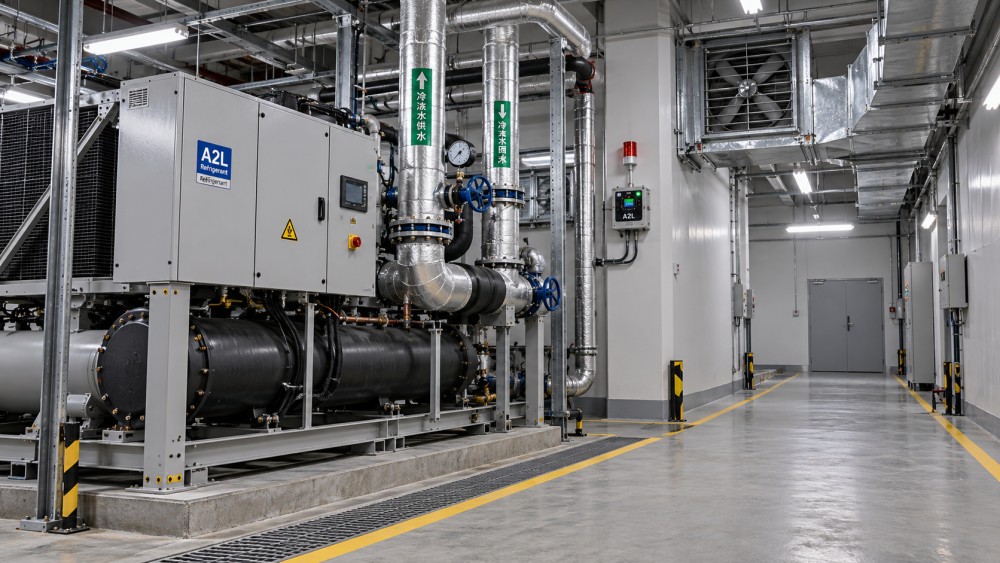
An indirect cooling arrangement can make the project easier to manage. Locating the refrigerant circuit in an appropriately designed package and circulating water or another secondary fluid to the process can reduce refrigerant distribution through occupied areas. This approach may allow substantial plant infrastructure to remain in service, although it introduces its own pumping, heat-transfer, and temperature-control considerations.
For an existing direct-expansion installation with long pipe runs and multiple evaporators, the assessment can be more demanding. Refrigerant inventory, connections, occupied spaces, and leak locations all become part of the conversion scope. Splitting circuits or changing the distribution architecture may be technically possible, but extensive alterations can shift the economic case toward replacement.
Confirm performance at the plant’s actual operating conditions
Once the approval and installation questions have a viable answer, the next task is to establish whether the converted machine can perform its duty. A refrigerant with a similar pressure-temperature relationship can still produce different capacity, compressor loading, discharge temperature, mass flow, and heat-transfer behavior.
The comparison should use the plant’s required operating envelope. For process cooling, that includes the lowest required supply temperature, return temperature, peak load, minimum stable load, and expected ambient or cooling-water conditions. A machine that performs adequately at a nominal rating point may struggle during hot weather, rapid load changes, or low-load operation.
Compressor suitability needs particular attention. The proposed refrigerant and lubricant combination must be supported, and operation must remain within the approved envelope. Motor loading, discharge temperature, oil return, and capacity control can constrain the usable range. Retaining the compressor is valuable only if it can deliver reliable service across the required conditions.
Other components need more than a visual inspection. Expansion devices may need different sizing or control settings. Seals, gaskets, lubricants, and motor insulation require compatibility review. Heat exchangers and piping must be suitable for the pressure and temperature conditions, while pressure protection arrangements need assessment for the modified system. A higher pressure rating alone does not establish overall compatibility.
Some A2L refrigerants are blends with temperature glide. Where glide is significant, it affects how evaporator and condenser temperatures are interpreted and how superheat and subcooling are evaluated. Heat exchanger selection and control settings must reflect the actual fluid properties. Depending on the blend and leak circumstances, refrigerant composition can also influence the prescribed recovery and recharging procedure.
Efficiency claims should be tested against the proposed system configuration. Compressor energy is only part of the result: condenser fans, secondary pumps, ventilation, and control strategy can affect plant electricity use. Additional safety measures do not necessarily eliminate an efficiency benefit, but their energy and maintenance demands belong in the comparison.
The acceptance criteria should be agreed before conversion work begins. Useful criteria include delivered capacity at defined conditions, temperature stability, electrical demand, compressor operating limits, leak tightness, and the verified operation of protective controls. Where cooling supports production, the commissioning plan also needs a response for a machine that cannot meet duty on restart.
Choose between conversion, package replacement, and continued operation
Conversion is most attractive when there is a documented engineering route, the equipment has substantial remaining service life, and the installation needs manageable changes. It becomes less attractive when the project requires major control reconstruction, extensive piping alterations, new ventilation infrastructure, and uncertain equipment approval.
Age alone is an incomplete guide. An older, well-documented industrial package may justify detailed evaluation, while a newer unit with no supported conversion route may be a poor candidate. Condition, maintenance history, parts availability, corrosion, and the expected life of major components all affect how much investment the retained equipment can reasonably support.
Three options deserve a consistent comparison:
- Convert the existing refrigerant circuit where the technical and regulatory route is established and the retained equipment offers useful remaining life.
- Replace the refrigeration package where an A2L-designed unit can connect to suitable existing utilities and process distribution.
- Continue operating the existing system for a defined period where lawful operation, maintenance support, refrigerant availability, and condition make that a defensible interim choice.
Keeping an existing system in service should not be dismissed merely because a lower-GWP alternative exists. Equally, a low conversion price should not dominate the decision if it leaves the plant with aging heat exchangers, limited controls, and difficult maintenance. The relevant comparison is the cost and reliability of delivering the required cooling over the intended ownership period.
That comparison should include engineering, approval work, components, refrigerant, installation, commissioning, production downtime, energy, maintenance, and eventual replacement. For a plant with little cooling redundancy, temporary cooling and restart risk may carry more weight than the difference in equipment purchase price. Any claimed savings should state the load profile and operating assumptions behind them.
Service capability is another selection condition. Technicians need suitable training, procedures, and equipment for the refrigerant and system involved. Recovery equipment, leak detectors, and other service tools must be appropriate for A2L use where required. The site also needs workable arrangements for refrigerant storage, hot work, emergency response, and maintenance of protective devices.
A converted machine creates an ongoing documentation obligation. Updated refrigerant identification, charge information, wiring diagrams, control descriptions, service instructions, and records of the modification help future technicians maintain the intended safety arrangements. If the local service organization cannot support those requirements, the apparent savings from conversion can be difficult to sustain.
For a technical evaluation, the most useful first deliverable is a documented feasibility decision covering the exact refrigerant, equipment model, installation location, approval route, and required cooling duty. If manufacturer support or installation compliance remains unresolved, detailed energy-payback estimates are premature. If those conditions are established, performance verification and a realistic ownership-cost comparison can determine whether to convert the circuit or retain the surrounding plant and replace the package.
Related News
- Is an IE4 Motor Upgrade Worth It for a Mostly Part-Load Compressor?Oct 28, 2026
- Are Butterfly Valves Suitable for Isolating Factory Compressed Air Mains?Oct 28, 2026
- How Do You Calculate Globe Valve Pressure Drop in Cooling Water Lines?Oct 28, 2026
- How Do You Calculate Air-Source Heat Pump Payback for a Factory?Oct 28, 2026
- How Do You Calculate a Compressor Cooling Pump's Lifecycle Cost?Oct 28, 2026
- How Do You Size a Cooling Tower for a Compressor?Oct 28, 2026