
How seal water temperature limits liquid ring vacuum pump performance
A liquid ring vacuum pump can meet its rated duty during selection yet lose suction capacity when the plant’s seal water becomes warmer. The immediate consequences may be longer evacuation times, rising process pressure, or unstable operation during peak cooling demand. Warmer seal water raises water vapor pressure, leaving less capacity for process gas and reducing the pump’s usable vacuum range.
For engineers evaluating Liquid Ring Vacuum Pumps, the first check is therefore not motor size or nominal pumping speed. It is whether the supplier’s performance curve represents the actual seal water temperature, flow, and gas duty. Compare the required absolute suction pressure with water vapor pressure, then obtain corrected capacity and the manufacturer’s cavitation operating limits for the hottest credible operating condition.
The temperature limit starts inside the liquid ring
The impeller maintains a rotating ring of liquid inside the casing. Changing volumes between the blades admit, compress, and discharge gas. Seal water acts as the working liquid, helps seal internal clearances, and absorbs heat from compression and the incoming process stream.
Some of that water evaporates into the gas spaces. As temperature rises, its saturation vapor pressure increases, so water vapor occupies a larger share of the pressure and volume available inside the pump. At a given suction pressure, this generally reduces the amount of noncondensable process gas that the pump can handle.
The relevant temperature is the liquid temperature within the operating pump, not simply the cooling water supply temperature. Inlet seal water temperature is usually the practical reference used on performance curves, but compression, condensation, and internal circulation can make the ring warmer. Supplier correction methods account for these effects more reliably than a calculation based only on incoming water.
These are rounded physical-property values for pure water, not guaranteed pump operating limits. They show why a temperature increase becomes especially important at low absolute pressure. A duty requiring 50 mbar absolute cannot be treated as a normal water-ring operating point when the working water is at 35°C: the water’s saturation pressure is already above the requested suction pressure.
A useful operating point needs more than a positive difference between suction pressure and water vapor pressure. Local pressures within the pump can be lower than the pressure measured at its inlet. Hydraulic behavior, temperature rise, and pump geometry determine the additional margin required.
Lost capacity and cavitation are related, but not identical
Capacity can deteriorate before obvious cavitation develops. A pump may continue running smoothly while process pressure rises because more of its gas-handling volume is occupied by water vapor. Where the duty includes condensable vapor, warmer water can also reduce internal condensation, leaving more vapor for the pump to compress.
Cavitation occurs when liquid vaporizes in low-pressure regions and the resulting cavities collapse as pressure recovers. Possible symptoms include crackling or gravel-like noise, vibration, and erosion of internal surfaces. These symptoms are not conclusive by themselves; mechanical damage, entrained solids, and unstable water delivery can produce overlapping indications.
A catalog’s ultimate pressure is not automatically an acceptable continuous operating pressure. It may describe a limiting test condition with little useful process-gas throughput. Continuous-duty selection needs an allowable operating region at the actual water temperature, including any required anti-cavitation provision.
Some pumps use a controlled gas bleed or a manufacturer-designed anti-cavitation connection to prevent excessively low internal pressure. This can protect the pump, but it introduces additional gas load and may affect achievable vacuum. It should not be treated as a substitute for adequate cooling or applied without confirming process compatibility.
Read the curve against the actual duty
A performance curve is meaningful only with its stated test conditions. Before comparing competing pumps, establish whether their capacities refer to the same suction pressure, gas temperature, seal water temperature, rotational speed, and discharge pressure. Also check whether capacity means actual inlet volume, standardized gas volume, or a stated dry-gas equivalent.
- Use absolute pressure: vacuum gauge readings depend on atmospheric pressure. Convert them before comparing the process requirement with vapor-pressure data or pump curves.
- Separate gas components: identify noncondensable gas, water vapor, other condensable vapors, and expected air leakage. They do not impose identical pumping or thermal loads.
- Identify the water reference point: confirm whether the quoted temperature is measured at the pump connection, a package inlet, or another specified location.
- Check discharge conditions: separator pressure, vent restrictions, and discharge piping losses can change compression duty and performance.
- Request temperature-corrected data: obtain capacity, absorbed power, seal water requirement, and the allowable pressure range at the intended operating conditions.
Do not apply one generic percentage correction per degree of water temperature. The effect is nonlinear and becomes much stronger as suction pressure approaches the working liquid’s vapor pressure. Corrections also differ between designs, including single-stage and two-stage pumps.
A simple vapor-pressure calculation can flag a questionable selection, but it cannot validate one. It does not fully represent internal heating, liquid carryover, condensation, or the pump’s hydraulic characteristics. For an acceptance specification, define the required gas-handling capacity at the specified inlet conditions rather than relying solely on a nominal model rating.
Find where the seal water gains heat
When vacuum deteriorates during warm weather or after extended operation, record conditions together. A temperature reading taken after the process load has fallen can conceal the cause of the earlier pressure rise.
Useful simultaneous readings include suction pressure at the pump and process vessel, seal water inlet and discharge temperatures, seal water flow, separator pressure and level, and cooling-side temperatures across any heat exchanger. Motor current adds context, but it does not directly measure gas-handling capacity.
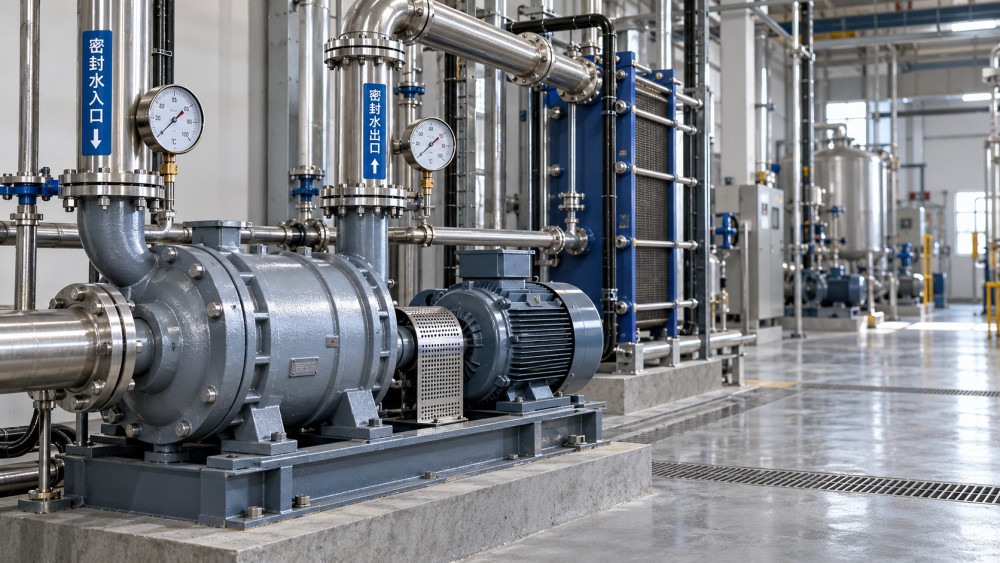
- Confirm the pressure measurement. Check instrument calibration, absolute versus gauge units, and the pressure drop between the vessel and pump. A blocked inlet strainer can make vessel pressure poor while the pump inlet operates at a much deeper vacuum.
- Measure water at the pump connection. A remote utility header may be cooler than the water actually entering the casing, particularly with recirculation or bypass mixing.
- Verify flow rather than valve position. Fouled strainers, inadequate supply pressure, worn circulation pumps, or partially blocked lines can reduce flow despite an unchanged valve setting.
- Inspect the heat rejection path. Check exchanger fouling, cooling utility flow and temperature, bypass leakage, and separator operation. Include heat released by condensing process vapor.
- Compare matched operating periods. If pressure recovers as seal water cools while process load remains comparable, the temperature relationship becomes more credible. Do not attribute every improvement to cooling when gas load has also changed.
An increasing difference between seal water inlet and outlet temperatures can indicate higher heat input or insufficient flow. It is not a diagnosis on its own. Condensation, changing gas throughput, and measurement location can all affect that difference.
Cooling arrangements set different practical limits
Once-through water supply
Once-through operation can deliver relatively stable inlet temperature when the supply is stable, but seasonal changes may still invalidate a selection based on colder water. Available pressure and flow must be checked during simultaneous utility demand, not only when the pump operates alone.
Increasing water flow is useful only within the manufacturer’s specified range. Excess flow can increase power demand, disturb operation, and overload the discharge separation system. It also raises water consumption and wastewater handling requirements without necessarily correcting an inadequate supply temperature.
Partial or total recirculation
A recirculating package accumulates heat unless that heat leaves through a cooler, discharged liquid, or another designed route. Cool initial fill water can temporarily mask insufficient steady-state cooling. A short commissioning run may therefore appear satisfactory even though continuous operation will not be.
For a recirculation cooler, establish the heat duty from the complete process and pump balance. It includes the relevant share of pump power, sensible heat from the incoming stream, and latent heat from vapor condensation. Account for hot makeup water, fouling allowance, and the actual cooling utility conditions.
Cooling water temperature alone does not define seal water temperature. The exchanger needs a temperature approach to transfer heat, and that approach changes with flow, fouling, and load. An evaporative cooling system is constrained by ambient wet-bulb conditions and its approach; an air-cooled system is constrained by dry-bulb temperature and exchanger approach.
Choose the remedy before increasing pump size
Where performance has degraded from an established baseline, first restore the intended water flow and cooling performance. Cleaning a fouled exchanger, repairing a bypass valve, or correcting separator level control addresses a different problem from selecting more displacement.
For a new installation, compare cooling improvements with pump changes at the same worst-case duty. More heat-transfer area may reduce the approach to the cooling utility, but it cannot cool below that utility’s temperature without another cooling method. Refrigerated cooling can lower seal water temperature further, at the cost of additional energy, controls, and maintenance.
A larger liquid ring pump may provide more capacity at a feasible operating point, but it does not remove the vapor-pressure limitation. Its additional heat rejection can also increase the burden on an already undersized recirculation cooler. Two-stage designs can improve deep-vacuum performance, yet still require temperature-corrected selection.
Changing to a lower-vapor-pressure working liquid is a separate engineering decision. Confirm viscosity effects, material compatibility, process contamination risk, separation behavior, and disposal requirements. Water-based curves cannot simply be reused for another liquid.
Before approving the package, require a documented continuous-duty point covering maximum seal water inlet temperature, specified gas composition and load, suction and discharge pressures, water flow, absorbed power, and cavitation protection. Define where each condition will be measured during testing. A package demonstrated only with cold water has not demonstrated the capacity required on the plant’s hottest operating day.
Related News
- Is an IE4 Motor Upgrade Worth It for a Mostly Part-Load Compressor?Oct 28, 2026
- Are Butterfly Valves Suitable for Isolating Factory Compressed Air Mains?Oct 28, 2026
- How Do You Calculate Globe Valve Pressure Drop in Cooling Water Lines?Oct 28, 2026
- How Do You Calculate Air-Source Heat Pump Payback for a Factory?Oct 28, 2026
- How Do You Calculate a Compressor Cooling Pump's Lifecycle Cost?Oct 28, 2026
- How Do You Size a Cooling Tower for a Compressor?Oct 28, 2026