
How exhaust gas temperature affects waste heat boiler feasibility
A hot exhaust stream can appear to justify a waste heat boiler until the steam balance reveals that the required pressure leaves too little temperature difference for effective heat transfer. Exhaust gas temperature affects feasibility in two ways: it determines how much sensible heat is available and whether that heat is hot enough to produce useful steam. A high inlet temperature helps, but it cannot compensate for inadequate gas flow, limited operating hours, or an outlet temperature constrained by corrosion.
For Waste Heat Boilers, the useful starting point is therefore not “How hot is the exhaust?” but “How much heat can be transferred to the required steam system throughout normal operation?” Answering that question before requesting equipment quotations helps avoid oversized heating surfaces, unrealistic steam guarantees, and capital estimates that exclude essential gas-handling modifications.
Start with the usable temperature window
The recoverable sensible duty depends on gas mass flow and the enthalpy difference between the boiler inlet and the lowest acceptable outlet condition. For preliminary screening, it can be expressed as:
Recoverable gas-side duty ≈ gas mass flow × average specific heat capacity × (inlet temperature − feasible outlet temperature).
This approximation is useful when gas composition remains reasonably stable and no condensation occurs. A detailed balance should use temperature-dependent gas properties, measured composition, and a consistent wet or dry basis. It must also account for heat losses and any energy carried out through blowdown when estimating steam production.
The outlet temperature is not an arbitrary target. It may be limited by the boiler’s temperature profile, acid or water dew points, downstream equipment requirements, or the need to maintain stack performance. Selecting an aggressively low outlet temperature simply to increase calculated recovery can make an otherwise credible feasibility study misleading.
Mass flow deserves equal attention. A very hot, small exhaust stream may contain less recoverable energy than a cooler stream with substantial flow. Where flow is reported volumetrically, confirm reference temperature, pressure, moisture content, and whether the value represents actual or standard conditions before comparing proposals.
Steam pressure sets the thermal hurdle
A boiler does not recover heat against a single cold-side temperature. Feedwater first warms toward saturation, water evaporates at approximately the saturation temperature corresponding to local pressure, and a superheater, if fitted, raises steam temperature further. Each section faces a different gas-to-fluid temperature difference.
Increasing steam pressure raises saturation temperature. That reduces the temperature difference available in the evaporator and can reduce recoverable duty unless inlet conditions or heating surface change. An exhaust stream that supports low-pressure saturated steam may be unsuitable for a higher-pressure header, even though it remains much hotter than ambient air.
Check the pinch before accepting an outlet temperature
In a conventional heat-recovery arrangement, the evaporator pinch is commonly described as the difference between the gas temperature leaving the evaporator and the saturation temperature of the boiling water. A smaller pinch can improve recovery, but generally requires more heat-transfer surface. The exact definition and design point should be stated in the supplier’s calculation.
The economizer approach is a separate consideration: it describes how close the economizer outlet water comes to saturation. Driving this approach too tightly can promote unwanted steaming under changing operating conditions unless the equipment and controls are designed for it.
A temperature-versus-duty diagram exposes these constraints more clearly than inlet and outlet temperatures alone. It should show the gas cooling curve alongside feedwater heating, evaporation, and any superheating. A proposed design must maintain a feasible local temperature difference throughout the heat exchanger, not just at its terminals.
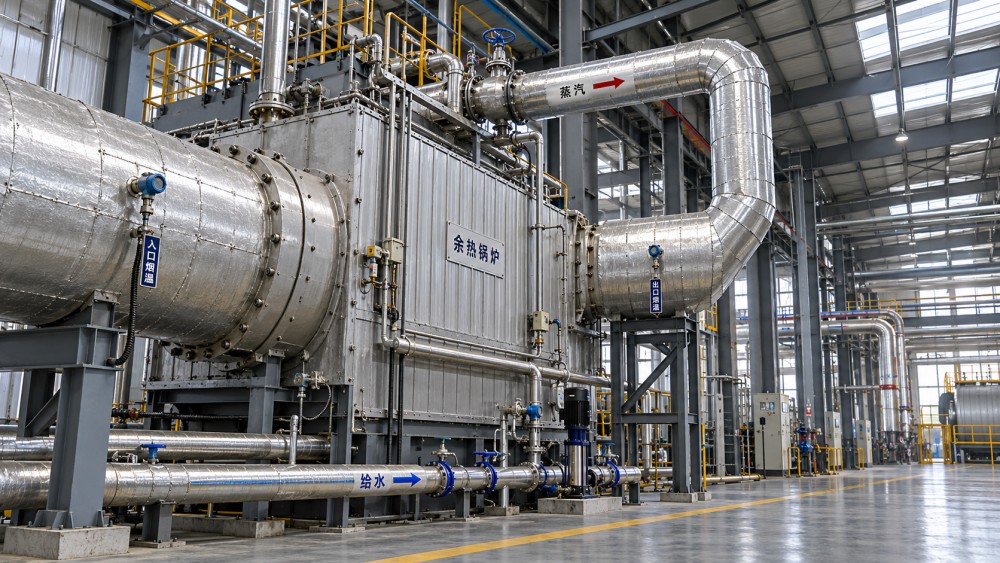
Where a high-pressure steam requirement creates a poor thermal match, assess a lower-pressure steam service or hot-water duty before rejecting recovery altogether. However, the alternative only has value if there is a credible demand at that temperature and pressure. Producing steam that must routinely be vented does not create useful savings.
Lower exhaust temperatures can increase equipment cost
As the driving temperature difference falls, more surface is generally required for a given duty. The relationship is commonly represented by Q = U × A × ΔTlm, where U is the overall heat-transfer coefficient, A is surface area, and ΔTlm is the logarithmic mean temperature difference. Complex arrangements may require correction factors or a sectional thermal model rather than a single overall calculation.
This explains why the final increment of heat recovery can be disproportionately expensive. Extending an economizer to extract additional low-temperature heat may add considerable surface while delivering only a modest increase in useful output.
The practical limit is not surface area alone. More tube rows, denser fins, or higher gas velocities can increase pressure drop. An engine, turbine, kiln, or process exhaust system may have a strict backpressure limit. Exceeding it can reduce source equipment output, disturb process draft, or require additional fan power.
For dirty gas, a compact surface arrangement may also foul too quickly to maintain its clean-condition rating. Compare proposals using agreed fouling assumptions, end-of-run pressure drop, cleaning access, and the expected interval between cleaning outages. A larger, more accessible boiler may preserve more annual recovery than a smaller unit with an attractive initial rating.
The cold end and hot end impose different limits
Acid dew point cannot be established reliably from exhaust temperature alone. Sulfur species, moisture, and other constituents matter; sulfuric acid condensation depends particularly on sulfur trioxide and water vapor. Fuel changes or upstream process changes can alter the safe operating envelope.
Bulk outlet gas temperature also does not guarantee that all surfaces remain above a corrosive condensation threshold. Tube metal near cold feedwater can be cooler than the surrounding gas. Startup, low-load operation, air ingress, and maldistribution can create local cold spots that are absent from a nominal heat balance.
Where condensation is intentional, treat the project as a condensing recovery application rather than simply specifying a lower stack temperature. Materials, drainage, condensate treatment, downstream ductwork, and stack compatibility must support the actual condensate chemistry.
At the hot end, more temperature is not automatically beneficial. Local metal temperature, circulation, tube cooling, refractory exposure, and deposit behavior may govern the design. Exhaust containing combustible components also requires assessment of possible downstream combustion or temperature excursions. A rated average inlet temperature does not define these hazards.
Use operating profiles, not one design point
A supplier’s full-load rating answers a narrow question: what the boiler can produce at stated conditions. Project feasibility requires a different answer: how much useful steam it will deliver while the source and steam users are actually operating.
Build an operating matrix covering normal loads, minimum stable operation, startup, shutdown, and credible upset conditions. For each steady operating case, record simultaneous gas temperature, gas mass flow, composition where variable, feedwater temperature, and steam demand. Avoid combining the highest measured temperature with a flow measured at a different load.
- Establish representative data. Use operating records or a measurement campaign long enough to capture relevant production variation. Check instrument location, calibration, and whether readings represent a mixed gas stream.
- Calculate feasible recovery at each load. Apply thermal-profile limits, cold-end constraints, fouling assumptions, and allowable pressure drop rather than holding one recovery percentage constant.
- Match output to demand. Identify when recovered steam displaces fired steam and when production exceeds the receiving system’s capacity.
- Apply availability and auxiliary loads. Include source outages, boiler maintenance, cleaning, pumps, fans, and operating restrictions that prevent recovery.
During low-load operation, both gas flow and temperature may fall. Steam production can therefore decline faster than a simple proportional adjustment from rated output suggests. Conversely, maintaining steam pressure while heat input varies can require bypass control or coordination with existing fired boilers. These arrangements affect both capital cost and recoverable energy.
A bypass may also be necessary to keep the production process operating when the recovery boiler is unavailable. Its need depends on the consequences of interrupting the exhaust path, but excluding it without reviewing plant availability can understate project scope.
Turn the temperature assessment into a defensible investment case
Annual savings should be based on useful recovered energy, not theoretical exhaust heat. Value steam according to the marginal fuel and operating costs actually displaced. Where the existing boiler remains online at lower load, its efficiency and minimum firing requirements may change; average historical steam cost can misrepresent the benefit.
Include the costs created by the temperature constraints themselves: additional heating surface, corrosion-resistant construction, gas cleaning, duct insulation, feedwater temperature control, bypass equipment, and access for inspection. Water treatment, blowdown, auxiliary electricity, and outage work also belong in the operating and capital estimates.
Test the investment against lower exhaust temperature, reduced operating hours, higher fouling, and weaker steam demand. These sensitivities show whether the project depends on optimistic assumptions. A design that remains acceptable under credible reduced-load conditions is more defensible than one justified only by the hottest available operating point.
Specify what a supplier must demonstrate
Request performance calculations at agreed operating points, with clear boundaries for gas conditions, feedwater conditions, steam pressure and quality, pressure drop, and fouling. Require the thermal profile, predicted outlet temperature, minimum-load behavior, and the basis for material selection. Distinguish guaranteed performance from estimates and define how acceptance testing will handle measurement uncertainty.
Pressure-equipment compliance must be established for the installation jurisdiction. In the United States, applicable state or local requirements may reference ASME boiler construction rules and impose inspection or operating obligations. In the European Union, assess the Pressure Equipment Directive’s applicability and conformity requirements. Neither framework replaces a site-specific review of exhaust hazards, controls, relief protection, and integration with existing equipment.
The project can move into detailed design when the operating envelope supports the required steam duty, local temperature differences are feasible, corrosion limits are defensible, and source backpressure remains acceptable. If those conditions cannot be demonstrated, revise the steam pressure, recovery target, or equipment arrangement before treating additional surface area as the solution.
Related News
- Is an IE4 Motor Upgrade Worth It for a Mostly Part-Load Compressor?Oct 28, 2026
- Are Butterfly Valves Suitable for Isolating Factory Compressed Air Mains?Oct 28, 2026
- How Do You Calculate Globe Valve Pressure Drop in Cooling Water Lines?Oct 28, 2026
- How Do You Calculate Air-Source Heat Pump Payback for a Factory?Oct 28, 2026
- How Do You Calculate a Compressor Cooling Pump's Lifecycle Cost?Oct 28, 2026
- How Do You Size a Cooling Tower for a Compressor?Oct 28, 2026