
What causes steam boiler carryover during sudden load changes?
Steam boiler carryover during a sudden increase in load is usually caused by a combination of falling pressure, drum-level swell, and rising steam velocity. As demand increases faster than the boiler can replace the withdrawn steam, pressure falls, steam bubbles within the boiler water expand, and some hot water flashes into steam. The water-and-steam mixture rises toward the outlet just as the steam-separation system must handle a larger volumetric flow.
High operating water level, foaming, contaminated boiler water, or unstable feedwater control can turn this temporary disturbance into substantial water entrainment. The key diagnostic question is whether the load change alone exceeds the boiler’s transient capability, or whether it exposes an existing chemistry, level-control, or separation problem.
Why a demand surge can lift boiler water into the steam outlet
A boiler operating steadily has an approximate balance between heat input, steam output, and feedwater supply. A process valve opening rapidly, a large batch starting, or another boiler disconnecting from a common header can upset that balance almost immediately. Combustion and heat transfer cannot necessarily respond at the same speed.
As pressure falls, the saturation temperature falls with it. Some of the energy stored in the hot boiler water produces additional steam, while existing bubbles expand. This increases the volume occupied by the water-and-steam mixture, creating swell: an apparent rise in water level even though steam withdrawal is reducing the boiler’s water inventory.
The elevated mixture leaves less disengagement space between the water surface and the steam outlet. At the same time, increased steam demand raises flow through that space and through any separators. Lower pressure also increases the specific volume of steam, so volumetric flow can rise more sharply than mass flow alone suggests. Droplets that would otherwise fall back into the water can be swept into the outlet.
This is why an apparently acceptable average steam load does not rule out carryover. A boiler may support a steady duty but struggle with the speed of the transition to it. The demand ramp, pressure excursion, initial water level, and separation arrangement all matter.
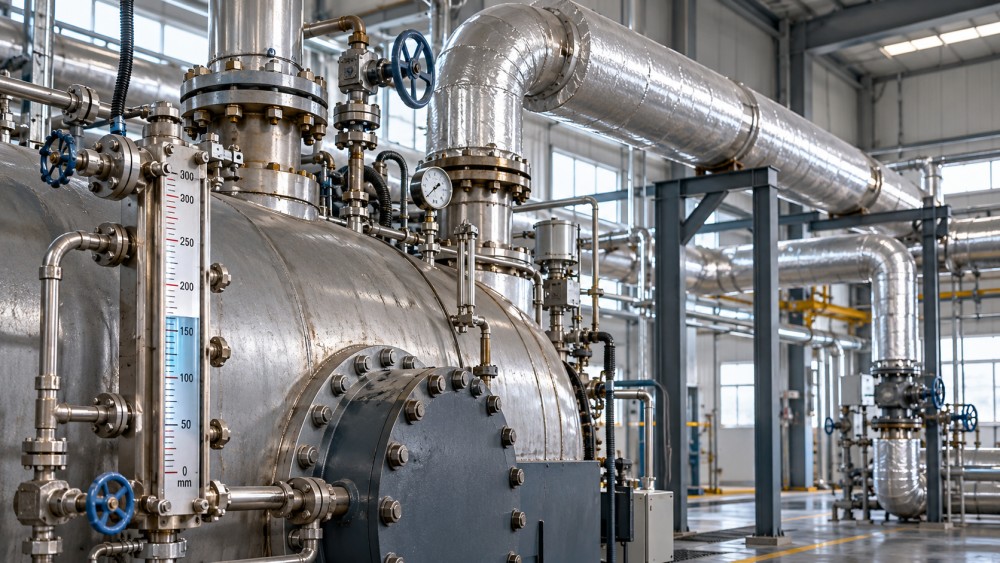
The level reading can move in the opposite direction to water inventory
Swell creates a control problem because the indicated level does not directly represent the mass of water available. A level-only feedwater controller can interpret a rising level as excess water and reduce feedwater precisely when steam withdrawal has increased.
When firing catches up and pressure recovers, the bubble volume decreases. The indicated level then falls, revealing the depleted inventory. Feedwater may respond aggressively, and poorly coordinated controls can produce repeated oscillations. Carryover can occur during the initial swell or a subsequent high-level overshoot.
The reverse disturbance matters too. When demand suddenly falls, pressure can rise and bubbles contract, causing shrink. A level-only controller may add water in response to the falling indication even though steam withdrawal has decreased. This can leave the boiler overfilled as conditions stabilize, reducing separation space before the next demand increase.
Three-element control uses steam flow, feedwater flow, and level to reduce this mismatch between inventory needs and transient level movement. It is not an automatic cure: measurement accuracy, valve response, tuning, and the transition between low-load and normal control modes still determine performance.
Conditions that turn a short upset into repeated carryover
A high starting water level
Operating near the upper end of the permitted level range leaves less room for swell. Raising the normal setpoint to provide “extra reserve” can therefore worsen wet steam during load changes. The appropriate operating level is the manufacturer’s specified level, not the highest level that avoids a high-level alarm.
A high indication also needs verification. Level-transmitter errors, blocked sensing connections, or unsuitable compensation can mislead the control system. Agreement between independent level indications is useful, but checks must follow the approved procedure for the installed equipment.
Foaming and contaminated water
Foaming creates a persistent layer of bubbles above the water surface. A demand surge can pull this foam into the outlet more readily than it would entrain droplets from a clean, stable surface. Excessive dissolved solids, unsuitable treatment conditions, and oil or process contamination can contribute.
Conductivity is a useful indicator for controlling dissolved solids, but it does not establish that the water is free from oil, organics, or other foam-promoting contaminants. Carryover that begins after a condensate-return change, process leak, or chemical-dosing adjustment warrants a chemistry investigation rather than control tuning alone.
Blowdown should follow the treatment program and boiler requirements. Arbitrarily increasing it during an upset can disturb level and pressure without removing the underlying contaminant source.
Excessive steam loading or ineffective separation
Steam boilers rely on water-surface area, disengagement space, and, where fitted, baffles, demisters, or cyclonic separators to limit moisture leaving the vessel. A rapid demand increase can exceed the effective separation capability even when pressure and level remain inside alarm limits.
Damaged, displaced, fouled, or incorrectly installed internals reduce that capability. If carryover persists at stable load with verified level and acceptable water chemistry, internal inspection becomes more relevant. This requires a properly isolated, cooled, depressurized boiler and qualified maintenance personnel—not an operating adjustment.
Confirm that the moisture actually comes from the boiler
Wet steam at a process connection does not, by itself, prove boiler carryover. Distribution piping produces condensate through heat loss. Poor drainage, failed traps, unsuitable pipe falls, or a cold branch opened rapidly can deliver water to equipment even when steam leaving the boiler is satisfactory.
The timing and location of symptoms help separate the causes:
Representative steam sampling, with properly designed sample conditioning, can help identify boiler-water contaminants in the steam. Elevated sodium or conductivity in condensed steam may support a carryover diagnosis, but contaminated sample lines or downstream sources can confuse the result. Steam purity and steam dryness are related but different measurements: neither should be inferred from the other alone.
What to do during an active event
Water hammer, severe level instability, or suspected water entry into vulnerable equipment requires the site’s abnormal-operation response. Do not continue loading the system simply to collect a clearer trend. Follow approved procedures for reducing demand, protecting affected equipment, and shutting down where required. Never bypass level protection or other boiler interlocks.
Where operation can safely continue, avoid abrupt manual corrections. Rapidly changing firing, feedwater, and process demand together can worsen the disturbance and obscure its cause. Stabilize the system within the approved operating envelope and preserve the event records.
Do not lower the water level aggressively to stop carryover. During swell, a high indication can coexist with declining water inventory. Likewise, suddenly closing steam valves to arrest a pressure drop can create a different pressure and level transient. Changes should remain within the manufacturer’s instructions and the site’s operating procedure.
Use the event sequence to identify the initiating fault
Trend data is more useful than a snapshot taken after pressure has recovered. Capture steam pressure, indicated level, steam flow, feedwater flow, feedwater-valve command or pump response, and firing demand on a common time base. The recording interval must be short enough to show the disturbance rather than smooth it away.
If steam flow rises first, pressure falls next, and level rises before feedwater changes appreciably, demand-driven swell is a strong explanation. If feedwater flow increases before the high-level event, investigate the control command, valve behavior, pump arrangement, and measurement signals. A valve command alone does not prove that the intended water flow occurred.
If level oscillates under otherwise stable demand, check control tuning, valve stiction, oversized control valves, unstable feedwater pressure, and transmitter performance. If moisture problems occur without a clear level excursion, chemistry, separation limits, and downstream condensate deserve greater attention.
In a multi-boiler plant, examine individual boiler flows and pressures rather than header pressure alone. An abrupt staging change, uneven load sharing, or sudden pickup by one unit can overload that unit’s separation capability while total plant demand remains within installed capacity.
Match the correction to the mechanism
For a genuine demand-ramp problem, the most direct correction is often to moderate how steam is admitted to the process. Staggering large users, using an engineered valve-opening sequence, or bringing sufficient boiler capacity online before a predictable batch starts can reduce the pressure dip. A steam accumulator may suit repetitive short peaks, but requires an engineered assessment of storage duty, pressure range, controls, and pressure-equipment requirements.
For control-driven events, verify instruments and final control elements before retuning. Tuning cannot compensate for a sticking valve, unreliable flow signal, or inadequate feedwater supply. Where three-element control is appropriate, its commissioning must include low-load operation and mode transitions, not just steady high-load performance.
For chemistry-driven carryover, correct the treatment condition and investigate the source of contamination. For persistent high level, restore the specified operating level and determine why it rose. For separation problems, assess actual duty against the manufacturer’s limits and inspect internals during a planned safe outage.
A downstream separator can remove entrained droplets within its design limits, but it does not correct boiler foaming, unstable level, or excessive internal loading. Successful correction is demonstrated by a repeatable operating response: pressure remains controlled through the expected demand change, level recovers without excessive overshoot, and steam quality meets the process requirement without relying on protective trips to manage normal operation.
Related News
- Is an IE4 Motor Upgrade Worth It for a Mostly Part-Load Compressor?Oct 28, 2026
- Are Butterfly Valves Suitable for Isolating Factory Compressed Air Mains?Oct 28, 2026
- How Do You Calculate Globe Valve Pressure Drop in Cooling Water Lines?Oct 28, 2026
- How Do You Calculate Air-Source Heat Pump Payback for a Factory?Oct 28, 2026
- How Do You Calculate a Compressor Cooling Pump's Lifecycle Cost?Oct 28, 2026
- How Do You Size a Cooling Tower for a Compressor?Oct 28, 2026