
A refrigeration purchase that meets today’s requirements can still carry tomorrow’s refrigerant supply, service, and compliance risks. Buyers should evaluate those risks before comparing prices.
For buyers evaluating Refrigeration Equipment, phaseouts and phasedowns make refrigerant choice part of the total cost of ownership, alongside energy consumption, maintenance, and production reliability.
The right decision depends on the installation’s jurisdiction, process duty, safety requirements, and maintenance capabilities. No refrigerant offers the best answer for every industrial application.
Procurement teams should shortlist legally suitable systems, verify performance under actual operating conditions, and price lifetime support before accepting a low bid or retrofit promise.
What do phaseouts actually change when you buy equipment?
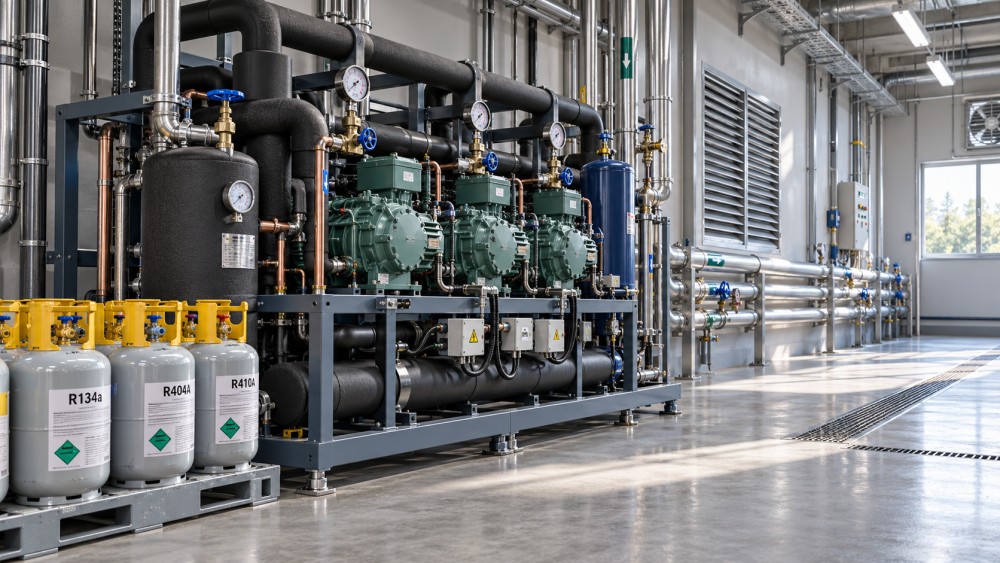
A phaseout generally eliminates specified substances or uses over time. A phasedown progressively reduces permitted supply, often through production and consumption controls expressed in equivalent emissions.
That distinction matters because reduced refrigerant supply does not automatically prohibit operating existing equipment. Restrictions on new systems, installation, servicing, and refrigerant sales can differ.
For example, older ozone-depleting refrigerants face different controls from hydrofluorocarbons, or HFCs. HFC phasedowns primarily address climate impact, although associated equipment restrictions vary by jurisdiction.
A system may remain serviceable after restrictions affect new equipment. However, keeping it running could require costlier refrigerant, stronger leak management, or specialized service arrangements.
Conversely, equipment offered for sale may face restrictions when installation occurs. Buyers must establish which event triggers compliance: manufacture, import, sale, installation, or placing into service.
Consequently, the purchasing question is broader than whether a refrigerant is currently available. Ask whether the proposed system has a credible operating and support pathway.
Which rules apply to your installation and delivery date?
Start with the physical installation location, equipment category, application, and expected commissioning date. A supplier’s general statement that equipment is compliant does not establish suitability.
In the United States, EPA implements HFC supply reductions under the AIM Act. Separate Technology Transitions requirements restrict certain refrigerants in specified new equipment applications.
EPA refrigerant management requirements also affect practices such as recovery, servicing, and leak management. Their applicability depends on the refrigerant, equipment, charge, and relevant rule.
In the European Union, Regulation (EU) 2024/573 combines an HFC quota framework with application-specific restrictions and other obligations. Different equipment categories have different compliance dates.
Other markets follow their own legislation and implementation schedules. Kigali Amendment commitments do not create one identical purchasing deadline across countries or industrial refrigeration applications.
Refrigerant permission is only one approval layer. Pressure equipment requirements, electrical rules, building codes, fire provisions, and occupational safety obligations can independently influence equipment selection.
For each bid, request the applicable legal provisions, refrigerant designation, stated global warming potential basis, equipment classification, and assumptions about installation timing and available exemptions.
Check current requirements through the US EPA HFC program or the EU F-gas regulation, then confirm local implementation with the responsible permitting authority before committing.
Which refrigerant options fit your process and maintenance capabilities?
Begin with cooling duty, required temperature, load variation, ambient conditions, and acceptable downtime. Then evaluate refrigerants alongside the system designs capable of meeting those requirements.
Lower global warming potential can reduce exposure to some regulatory pressures. It does not establish that a system will be efficient, inexpensive, or straightforward to operate.
Ammonia can suit substantial industrial loads, but its toxicity requires appropriate engineering and operating arrangements. Those requirements affect plant layout, staffing, training, and project costs.
Carbon dioxide requires attention to pressure and system architecture. Transcritical performance depends on ambient conditions and design features; cascade systems introduce different operating and maintenance considerations.
Hydrocarbons and some lower-GWP synthetic refrigerants introduce flammability considerations. Safety classifications differ, so procurement documents should identify the exact refrigerant rather than a broad family.
Request a site-specific explanation of ventilation, detection, relief discharge, electrical provisions, and access requirements. Ask who designs, supplies, approves, and maintains each necessary protective measure.
A technically attractive refrigerant becomes a weak purchase when local technicians lack training or essential components have long lead times. Confirm support before equipment selection.
How should buyers compare lifetime cost rather than purchase price?
Phaseouts increase the value of a structured ownership model. Compare installed capital cost, electricity, routine maintenance, refrigerant losses, compliance work, and production interruption over consistent periods.
Installed cost should include necessary machinery room changes, piping, electrical work, controls integration, safety systems, commissioning, and operator training. Equipment quotations often exclude these items.
Require energy estimates at your specified suction and condensing conditions, operating hours, and load profile. A favorable rating point may poorly represent actual annual consumption.
Include auxiliaries such as pumps, fans, cooling towers, defrost, and standby loads. Compare equivalent system boundaries so suppliers cannot shift energy consumption outside their quoted figures.
For refrigerant exposure, model several future price scenarios instead of assuming one forecast. Supply restrictions can affect prices, but timing and magnitude remain market dependent.
As a simple sensitivity check, a 500-kilogram charge losing five percent annually requires 25 kilograms of replacement refrigerant. Multiply that quantity by each price scenario.
Then add leak investigation, repair labor, recovery, testing, and lost production. Refrigerant purchase expense alone can substantially understate the business impact of recurring leakage events.
Where heat recovery is proposed, credit only useful heat that matches demand, temperature, and operating schedules. Include any effect on compressor energy and maintenance requirements.
Discount future costs consistently and show the assumptions. A transparent range gives procurement teams a stronger decision basis than a precise payback built on optimistic inputs.
Can a retrofit protect the investment later?
Treat “future-ready” as a claim requiring evidence. A refrigerant change can affect compressor capacity, discharge temperature, oil behavior, seals, valves, controls, and operating pressure limits.
A lower-GWP replacement may also introduce temperature glide or a different safety classification. Either change can require engineering review beyond simply recovering and replacing refrigerant.
Ask the original equipment manufacturer to identify approved alternatives for the exact model. Written approval should state component changes, operating limits, capacity effects, and warranty implications.
Require the supplier to distinguish a supported conversion available today from a possible future development. An unnamed replacement refrigerant provides little protection in an investment appraisal.
Also establish whether conversion would require revised certification, updated documentation, authority approval, or new safety measures. These costs can change the economics of the original purchase.
For existing equipment, compare conversion with continued maintenance and planned replacement. Consider remaining mechanical life, leakage history, energy performance, spare parts availability, and expected production downtime.
Reclaimed refrigerant can support some installed systems where legally permitted and technically suitable. Its future availability, quality assurance, and price should remain explicit assumptions, not guarantees.
What should every supplier include in its quotation?
A useful request for quotation turns regulatory and service concerns into comparable deliverables. Give every bidder the same process conditions, operating profile, and commercial assumptions.
Require the exact refrigerant, initial charge, safety classification, and applicable regulatory basis. Include expected shipment, installation, and commissioning dates so timing risks become visible early.
Ask for guaranteed cooling capacity and power input at specified site conditions, including part-load operation. Define tolerances, measurement boundaries, and acceptance testing before contract award.
Request maintenance intervals, service access requirements, critical spare parts, and technician qualifications. Identify the nearest capable service provider and proposed response times for production-critical failures.
Ask suppliers to explain charge reduction measures, leak detection, isolation arrangements, and refrigerant recovery provisions. These features can reduce both routine losses and repair consequences.
Define ownership of drawings, control backups, operating manuals, service records, and refrigerant documentation. Access to this information helps the buyer maintain options throughout equipment life.
Finally, document warranty exclusions, refrigerant availability commitments, and responsibility for regulatory changes before commissioning. Have commercial and legal teams review promises that influence the purchasing decision.
Should you buy now, delay, or replace in stages?
Buying now can make sense when capacity is urgently needed and a compliant, supportable design is available. Waiting also carries costs through downtime or inefficient operation.
Delaying can be reasonable when requirements are unresolved, an installation redesign is necessary, or competing technologies need application testing. Set a decision date and measurable milestones.
A staged replacement can spread capital spending and reduce commissioning risk. However, maintaining several refrigerant types may increase training, spare parts, tooling, and service coordination costs.
Before approving any option, test three scenarios: expected operating conditions, higher refrigerant and energy costs, and a major repair. Compare cash flow and production exposure.
If one bid remains attractive only under favorable assumptions, investigate those assumptions before negotiating price. The stronger purchase usually stays workable across a realistic operating range.
Make refrigerant choice a documented purchasing decision
Refrigerant phaseouts do not create a universal replacement deadline for every plant. They change the risks buyers must evaluate when selecting and supporting refrigeration equipment.
Choose equipment that meets applicable rules, delivers the required process duty, and fits your maintenance capabilities. Verify these conditions through written evidence and comparable performance commitments.
The purchase decision should connect refrigerant choice with installed cost, operating efficiency, service access, and a credible end-of-life plan. That connection protects both production and capital.